
Journal · Blinds · 6 min read
Outdoor alfresco blinds: keeping Melbourne weather out
Zip-track and channel blinds that turn an alfresco into a year-round room.
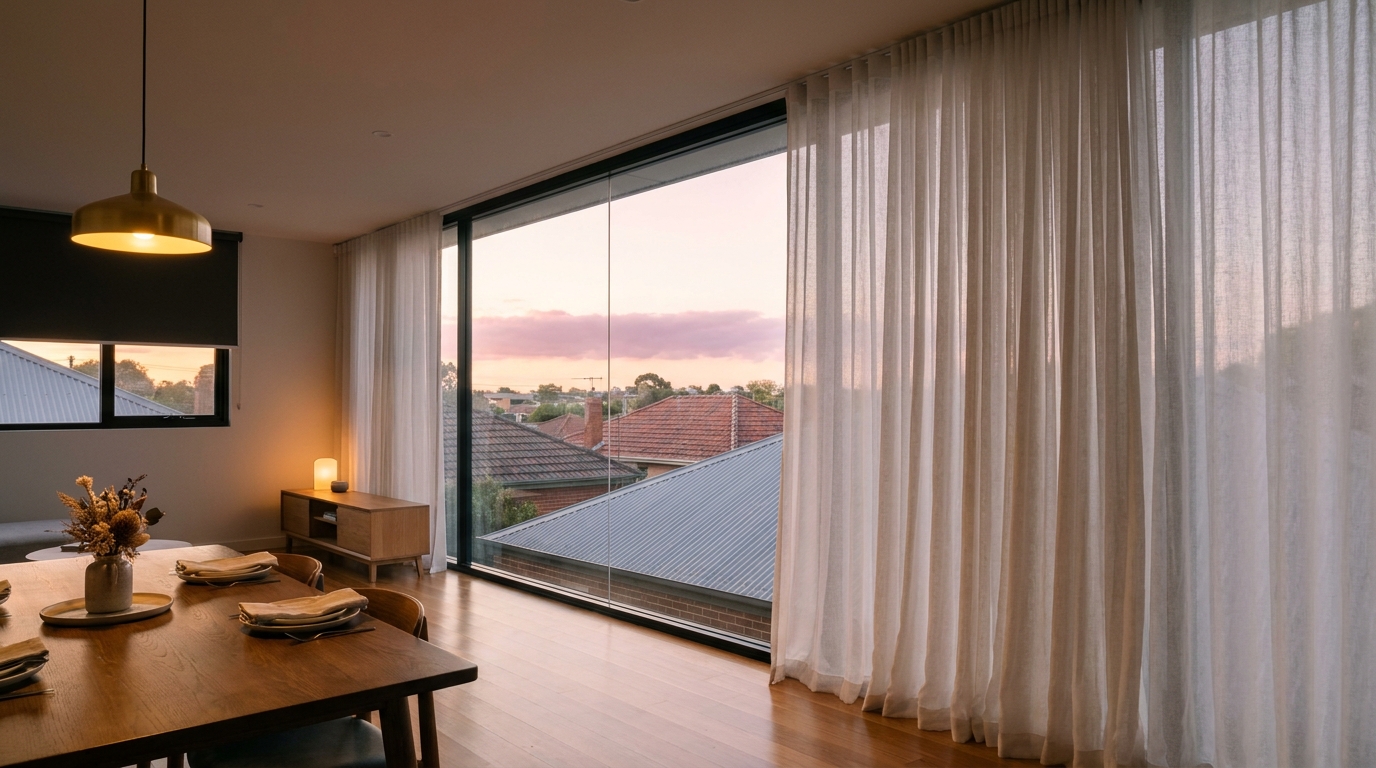
Zip-track outdoor blinds enclose a Melbourne alfresco area and turn it from an October-to-March room into a year-round room. The blind runs in a sealed aluminium track on each side; when fully lowered, the panel creates a wind, rain and insect barrier without losing the indoor-outdoor feel. For most Melbourne homes the right combination is a clear PVC blind for winter visibility and a mesh sunscreen blind for summer shade, on the same brackets where possible.
Key takeaways
- Zip-track means the blind fabric is sealed in a side track, not just running past it.
- Clear PVC blinds preserve the view in winter and block wind and rain.
- Mesh sunscreen blinds give summer shade and airflow without losing the view.
- Motorisation with a wind sensor is the smart spec on exposed alfrescos.
- Lead time on most outdoor blinds is four to six weeks.
- Wind exposure rating drives fabric and track choice; a sheltered alfresco is different to an exposed one.
What zip-track means
The traditional outdoor blind is a roll-down panel that ties off at the bottom with rope or hooks. The fabric flaps in the wind because the edges are unrestrained. Zip-track blinds run the fabric inside an aluminium track on each side. The fabric has a continuous keder (a rope-like edge profile) sewn into the side, and the track has a matching channel. When the blind drops, the keder slides into the track and seals the edge.
The practical difference is significant:
- Wind: zip-track holds in winds up to roughly 50 to 70 km/h depending on the spec. Rope-tied blinds flap and fail at much lower wind speeds.
- Rain: zip-track sealed edges block driving rain. Rope-tied blinds let it through the side gaps.
- Insects: zip-track sealed edges block mosquitoes and flies. Rope-tied blinds do not.
- Look: zip-track sits taut and flat. Rope-tied blinds are visibly loose.
For any new outdoor blind in Melbourne, zip-track is the standard. We do not install rope-tied outdoor blinds.
Fabric choice: clear PVC vs mesh
The two common outdoor blind fabrics serve different jobs.
Clear PVC (sometimes called cafe blind PVC):
- Keeps the view of the garden through the blind.
- Blocks wind and rain completely.
- Holds heat in the alfresco; works in winter to extend the usable season.
- Can fog or scratch over time; quality PVC lasts longer.
- Available in clear, smoke or bronze tints.
Mesh sunscreen:
- Blocks UV and direct sun while preserving airflow.
- Holds the view through but with a screened look.
- Does not block rain or wind effectively; not for winter.
- Works in summer to give shade without sealing the heat in.
- Available in 1 percent to 10 percent openness depending on shade level.
For most Melbourne alfrescos, two blinds on the same opening (one PVC, one mesh) is the right answer. The PVC drops in winter and bad weather, the mesh drops on hot summer afternoons. Both can run on the same bracket with a double track configuration.
Wind exposure and how it changes the spec
A sheltered alfresco (recessed under the main roof, with side walls of the house enclosing two or three sides) is a different specification problem to an exposed alfresco (free-standing pergola in an open yard).
- Sheltered, low exposure: standard zip-track in any fabric. Wind ratings to 50 km/h are sufficient.
- Moderate exposure: heavy-duty zip-track with reinforced tracks and beefier fabric. Wind ratings to 60 to 70 km/h.
- High exposure (south-facing, no surrounding shelter): heavy-duty zip-track plus motorisation with a wind sensor. The blind retracts automatically before wind damage occurs.
We measure wind exposure on the quote and recommend the appropriate spec. Specifying a sheltered-grade blind on an exposed location is a recipe for fabric and track damage in the first big southerly.
Motorisation and weather sensors
For any alfresco that gets used regularly, motorisation is the right choice. Manual operation on a 4m wide outdoor blind is heavy and wears the mechanism. A motorised blind on a switch or remote takes seconds.
The smart spec adds a weather sensor. The sensor reads wind speed (and optionally rain and sun) and triggers the blind to retract automatically when wind exceeds the safe threshold. For exposed alfrescos that get the southerly change, this is the difference between a blind that lasts ten years and one that fails in three.
Somfy and Automate both make outdoor blind motors with wind sensor integration. Both work with smart-home systems if the rest of the house is connected.
For the indoor blind context, see how to choose blinds for a north-facing Melbourne home.
Sequencing on a renovation
For a renovation that includes a new alfresco, the order is:
- Pergola or roof structure built and clad.
- Outdoor blind tracks fixed to the structure.
- Blind fabric measured to the actual track dimensions and ordered.
- Install four to six weeks later.
The sequence matters because outdoor blind tracks need to fix to solid structure (timber posts, steel columns, or face-fixed to a brick wall). Fixing into thin pergola battens or unsupported timber edges fails over time. Where the structure does not support the loads, additional posts or steel are added before the blind tracks go on.
For builder coordination across the rest of the home, see the builder fit-out checklist.
Common questions
Can outdoor blinds replace an outdoor heater?
In part. Sealing the alfresco with PVC blinds traps a meaningful amount of heat in the space. Combined with a single radiant heater, an enclosed alfresco can run comfortably on cold Melbourne nights. Without enclosure, the same heater struggles because the heat blows away.
How long does the PVC stay clear?
Quality PVC holds clarity for ten years plus. Cheaper PVC fogs or yellows within three to five years on west-facing exposure. The cost gap between standard and premium PVC is meaningful but justified on a regularly-used alfresco.
Can the blinds run on one wall and not the other?
Yes. Blinds can be specified per opening; you do not need to enclose every face of the alfresco. A common spec is blinds on the windward face only.
What is the warranty?
Manufacturer warranty on quality outdoor blinds runs 5 years on the mechanism and 2 to 3 years on the fabric. Workmanship warranty from us is 12 months.
Are outdoor blinds noisy in wind?
Zip-track blinds are essentially silent in wind because the fabric is sealed in tracks and cannot flap. The only noise is the very faint hum of fabric tension; nothing intrusive.
A free measure within 40km of Altona walks through wind exposure and fabric pairing on the actual alfresco. Call Dany on 0468 032 236 or browse the blinds range.
Read next