6 min read
Decorative window film for bathrooms and offices
Frosted, gradient, and patterned films that give privacy without losing light.
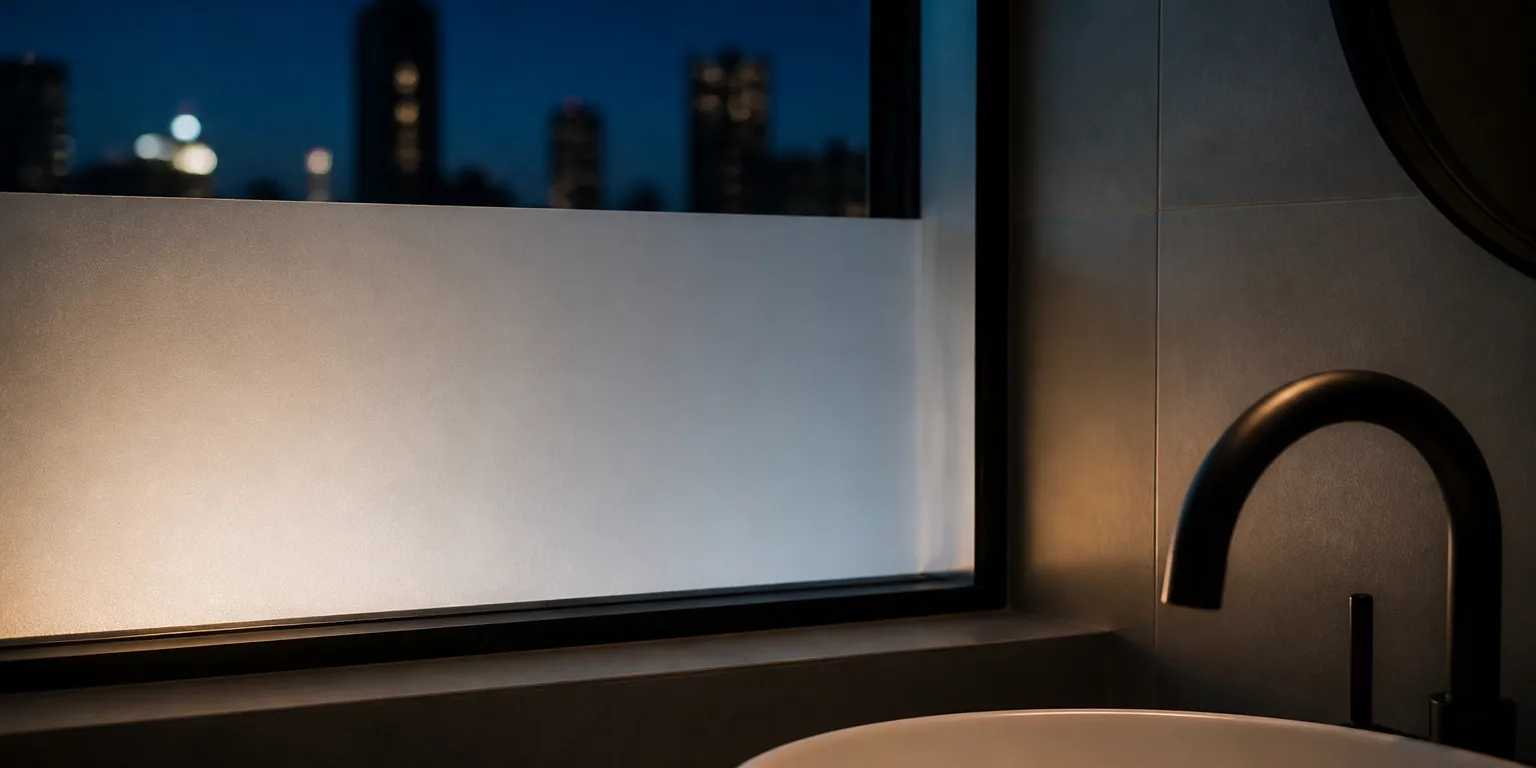
Decorative film solves a specific problem: a window where you need privacy but cannot give up the daylight. The most common candidates in Melbourne homes and offices are bathrooms, ensuites, ground-floor consult rooms, front-entry sidelights and boardrooms. Fully frosted film gives complete visual privacy and lets full daylight through. From inside the room it looks identical to frosted glass; from the street it reads as obscured glass, not as a film.
Key takeaways
- Frosted film is the bathroom default. Full opacity, full daylight transmission.
- Gradient film (frosted bottom, clear top) suits offices and street-facing windows.
- Patterned and cut films handle branding and decorative work.
- Significantly cheaper than replacing the glass with patterned or frosted glass.
- Most decorative film jobs are a half-day install.
- Manufacturer warranty runs 5 to 10 years on quality films from reputable brands.
Where decorative film belongs
The decision is simple. Where do you need privacy without giving up the light? In a Melbourne home that is usually:
- Bathrooms and ensuites, especially ground-floor or street-facing.
- Front-entry sidelights, where you want light in the hallway without a clear view from the porch.
- Stairwell windows that face a neighbour's wall.
- Garage or laundry windows that overlook a driveway.
In an office or commercial setting:
- Boardrooms (often gradient, with the clear top preserving the city view).
- Ground-floor consulting rooms and medical practice rooms.
- Reception sidelights with a logo or pattern cut.
- Glass partition walls in open-plan offices.
For the broader commercial film conversation, commercial window tinting in Melbourne covers solar, anti-graffiti and safety alongside decorative.
Window tinting
See what film actually does on your glass
Solar, privacy, frost and safety film, installed across Melbourne with a ten to fifteen year manufacturer warranty.
Frosted, gradient, patterned: what each one does
Fully frosted film gives uniform opacity across the entire pane. Light passes through but no detail is visible from either side. The film looks white from outside (similar to a frosted shower screen) and reads as soft daylight from inside. The bathroom default.
Gradient film is frosted at the bottom and clear at the top, with a transition zone in the middle. Common heights:
- Boardrooms: frosted to 1500mm above floor, clear above.
- Street-facing offices: frosted to 1800mm above floor, clear above.
- Bathrooms with a high view: frosted to 1200mm, clear above (rare; usually we go full frost in bathrooms).
The gradient is achieved either with a printed transition zone or with a cut-line at a specific height. Cut-line gradients are sharper; printed gradients are softer.
Patterned film comes in repeating designs (linear stripes, dots, geometric patterns). It is used where full frost reads as too institutional or where a softer pattern suits the design language of the room. The patterns range from subtle linen-look textures to bolder geometric grids.
Cut films are individual designs (often logos or signage) cut from frosted vinyl and applied to clear glass. Common in reception areas and on glass partition walls in offices. The cost is per design rather than per sqm because the cutting is the labour-intensive part.
Cost vs replacing the glass
The alternative to decorative film is replacing the glass itself with frosted, patterned or sandblasted glass. The cost difference is significant.
- Decorative film on existing glass: $80 to $120 per sqm installed for standard frost or gradient.
- Replacing single-glazed glass with frosted glass: $300 to $500 per sqm including glazier labour and disposal.
- Sandblasting existing glass: similar to replacement, plus mess and downtime.
For a typical bathroom window of 1 sqm, decorative film is roughly a quarter of the cost of glass replacement, with the same end result inside the room.
For the full pricing context across film types, see the honest cost of window tinting in Melbourne.
Install detail
Decorative film install is straightforward but demands a clean glass surface. The process:
- Glass is cleaned thoroughly with a tinting solution.
- The film is cut to size with a 2 to 3mm gap from the frame.
- Mounting solution is sprayed onto the glass.
- Film is positioned, squeegeed flat, edges trimmed.
- Final clean and inspection.
A single bathroom window is typically a 30 to 45 minute job. A four-window bathroom block is a half day. A whole-of-office gradient install across 50 sqm of glass is usually a day with two installers.
For offices, we install after-hours where possible to avoid disrupting business operations.
Free measure
Get a fixed price on your windows
Dany measures every window on site and quotes it honestly, so the number you sign is the number you pay.
Pairing decorative film with other privacy options
Decorative film vs blinds: in a bathroom, film is almost always the better answer. A blind has to be opened to let in light, and an open blind has no privacy. The film does both at once and never needs adjusting.
Decorative film vs sheer curtains: in a living room, sheer curtains usually win because they soften the architecture. In a small bathroom or laundry, there is no room or budget for a curtain track and film is cleaner.
Decorative film with a roller blind behind: occasionally specified in bedrooms with a window facing a close neighbour. The film handles daytime privacy; the blockout roller behind handles night privacy and light control.
Common questions
Will frosted film let me see shadows of people inside?
No. Quality decorative film blurs all detail completely. From outside you see the colour and shape of light through the glass but no figures or movement. The privacy is genuine.
Can decorative film be removed?
Yes. The film peels off cleanly with heat and a scraper. Adhesive residue is removed with the manufacturer's solvent. The original glass is unchanged. Removal of a 1 sqm window takes around 15 to 20 minutes.
Does it work on textured or patterned existing glass?
No. The film needs a smooth glass surface to bond. Textured glass (the rippled or hammered glass common in older bathrooms) cannot take film. The fix is replacing the glass with smooth glass first, then filming.
Will it block UV like solar film?
Most decorative films include UV-block as a baseline (typically 99 percent UV). The visible heat-rejection performance is lower than dedicated solar film, but for small bathroom windows that is rarely the priority.
Can I get a logo cut into the film?
Yes. We work with sign cutters who produce logo cut-outs from frosted vinyl. Lead time is typically a week for a custom cut. Cost depends on size and complexity.
A free measure within 40km of Altona walks through which windows suit film and which suit blinds. Call Dany on 0468 032 236 or browse residential tinting and commercial tinting.
Read next
Related service
Window Tinting →Frost tinting, one-way mirror film, solar heat reduction, decorative and safety film installed across Melbourne