
Journal · Curtains · 6 min read
S-fold vs pinch pleat curtains: a fitter's perspective
The two most common curtain headings, and which one suits your room.
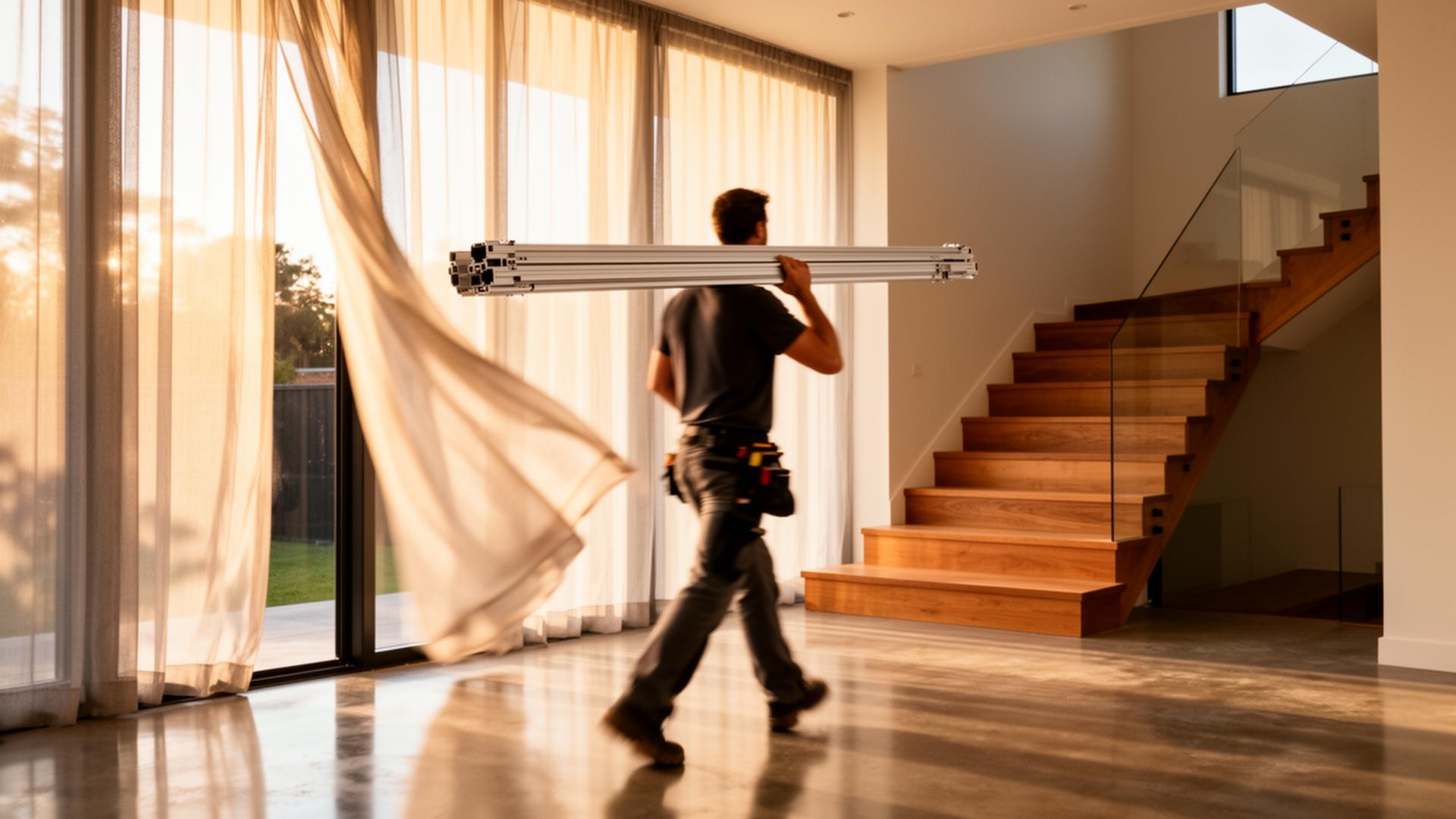
S-fold suits modern homes with flat ceilings, white walls and floor-to-ceiling glazing. Pinch pleat suits period homes with cornices, panelled walls and traditional joinery. The two are the most common curtain headings offered in Melbourne, they look genuinely different, and the right choice usually comes down to the architecture of the room rather than personal taste.
Key takeaways
- S-fold is a continuous wave former at the top of the curtain, giving an even ripple end to end.
- Pinch pleat is hand-tied groups of three folds at regular intervals along the top.
- S-fold suits contemporary architecture; pinch pleat suits period and transitional homes.
- Pinch pleat takes more stack space when drawn back. S-fold stacks tighter.
- Pinch pleat is more labour-intensive to make and costs marginally more.
- Both work on sheers and on blockouts. The fabric weight changes which heading reads correctly.
The mechanical difference
S-fold uses a track fitted with carriers at evenly spaced intervals (usually 80 to 100mm apart). The top of the curtain has a stiffened tape; pins from the carriers slot into pockets in the tape. The result is a continuous, even wave from one end of the track to the other. The folds are uniform in depth and spacing.
Pinch pleat is built differently. The top of the curtain is gathered into groups of three folds, hand-tied or hand-stitched at the base of the pleat. Each pleated group hangs from a single hook in a regular gliding track. Between the pleats, the fabric falls flat. The result is a tailored, structured top with deeper folds at the pleats and a flatter zone between.
The practical implication: an S-fold curtain reads as flowing, an unbroken ripple. A pinch pleat reads as structured, with a clear repeating rhythm.
Which heading suits which room
S-fold belongs in:
- New builds with flat ceilings and recessed ceiling tracks
- Rooms with floor-to-ceiling glazing where the curtain runs from ceiling to floor
- Modern interiors with minimal trim and white walls
- Sheer curtains, especially in lighter linen-blends. The wave shows the fabric to its best advantage.
Pinch pleat belongs in:
- Period homes (Federation, Victorian, Edwardian)
- Rooms with deep cornices, ceiling roses or panelled walls
- Bay windows where the structured top reads as part of the architecture
- Heavier blockout fabrics where the pleat structure holds the weight
For the broader sheer curtain conversation, sheer curtains and Melbourne western light covers fabric weights and colour choice. For the related question of whether a Roman blind might do the same job, see roller vs Roman blinds.
Stack space and how it changes the spec
When a curtain is fully drawn back, it sits stacked against the wall on one or both sides. The width of that stack matters because if you do not have wall on either side of the window, the stacked curtain blocks part of the glass.
S-fold stacks at roughly 12 to 15 percent of the rod length per side. On a 4m opening that is 480 to 600mm of stack space per side.
Pinch pleat stacks at roughly 18 to 22 percent of the rod length per side. On the same 4m opening that is 720 to 880mm. That extra 240mm per side matters on a window that opens straight to a return wall or a doorway.
For narrow openings or windows close to a corner, S-fold is the more practical choice because it preserves more glass when drawn back.
Cost difference
Pinch pleat is more labour-intensive than S-fold. Each pleat is hand-tied. The maker spends meaningfully more time per linear meter of curtain, and the cost reflects that. Across a four-bedroom home full of curtains, the cost gap between the two headings can run into four figures.
The trade-off is durability. The pleated structure of pinch pleat is mechanically more durable than the wave-tape-and-pin system of S-fold. Both will last fifteen years plus in domestic use, but a pinch pleat curtain rehung after a move-in or a paint job tends to look correct without much fiddling. S-fold needs the pins reset evenly to look right.
Track and rod options
S-fold runs on its own ripple-fold track system. The track is the engineered part; the curtain is essentially flat fabric with a header tape. Pinch pleat runs on a regular gliding track or on a decorative pole with rings.
If you want a visible decorative pole (timber or metal), pinch pleat with rings is the only option. S-fold is always concealed-track. In period homes where a brass or timber pole reads correctly with the architecture, this often pushes the heading choice towards pinch pleat.
Common questions
Can I have S-fold sheers and pinch pleat blockouts on the same window?
Yes, on a double track system this works fine and is occasionally specified. The sheer is the more visible layer through the day, so the S-fold reads as the primary look. The blockout is mostly seen drawn at night, when the heading detail matters less.
Do S-fold curtains lose their wave over time?
If hung correctly with the right number of carriers and the right fabric weight, the wave holds for the life of the curtain. Issues come from undersized fabric (not enough fullness), wrong carrier spacing, or wrong header tape. A reputable maker gets all three right.
Which heading is better for a kid's bedroom?
Pinch pleat in a blockout fabric on a regular gliding track. The structure is solid, the cord-free options are widely available, and the heading does not depend on evenly seated pins.
Can pinch pleat work in a contemporary home?
Yes, in a tailored linen-blend in a neutral tone, pinch pleat reads as transitional rather than traditional. The look works in contemporary homes that lean towards textured, layered interiors rather than minimalist white.
What is the lead time on each?
Three to four weeks for both, occasionally longer on imported fabrics. The heading itself does not significantly change the manufacturing time.
A free measure includes both heading samples held against the actual fabric, in the actual room, in the actual light. The difference is obvious in person. Call Dany on 0468 032 236 or browse the curtains range.
Read next