
Journal · Blinds · 6 min read
Roller blinds vs Roman blinds: which suits your space
Both are popular in Melbourne homes. Each has a job it does better than the other.
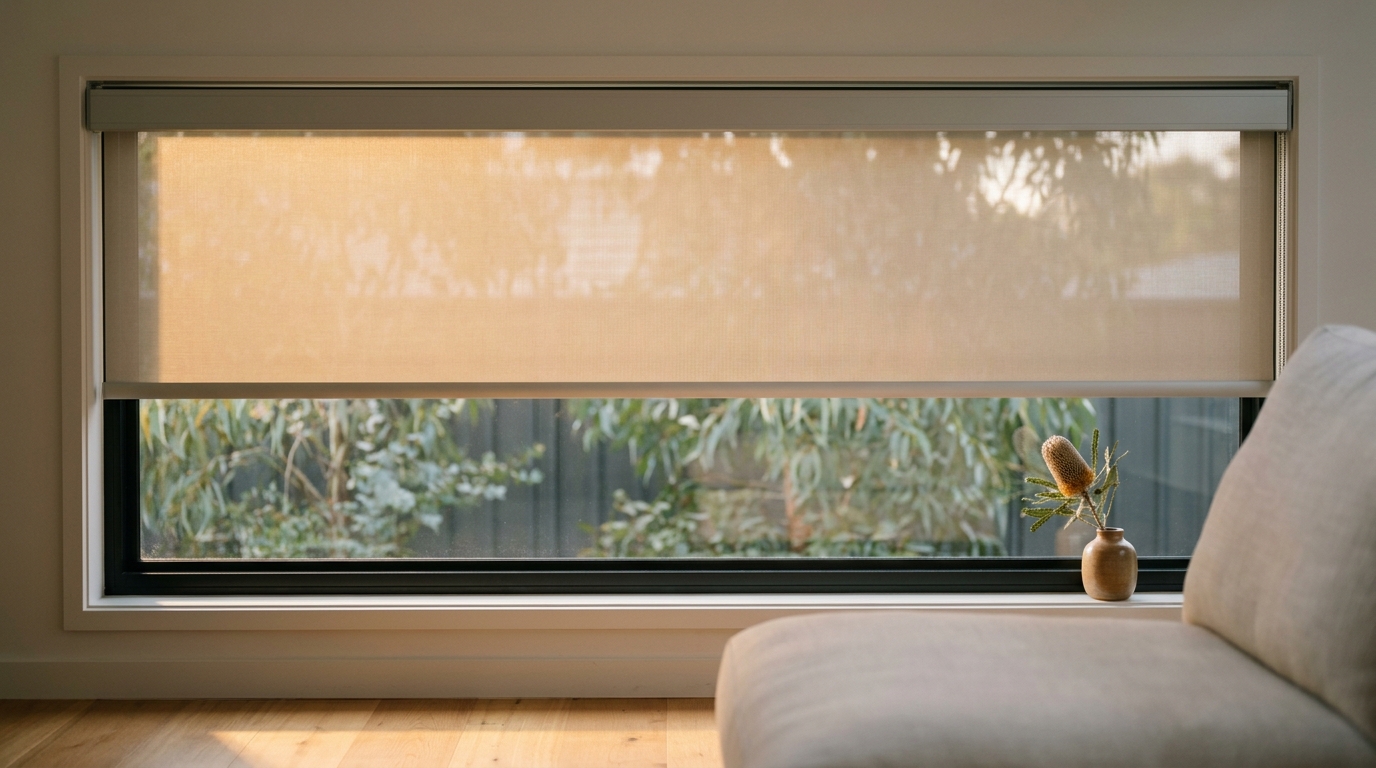
Roller blinds suit wet areas, kids rooms, kitchens and any window where a clean modern line matters. Roman blinds suit formal living rooms, period homes and bedrooms where soft folded fabric reads better than a flat panel. The two get treated as alternatives, but they solve slightly different problems. A roller is a flat sheet of fabric on a tube. A Roman folds into stacked horizontal pleats and feels closer to a curtain.
Key takeaways
- Rollers are the right default for kitchens, bathrooms, laundries and home offices.
- Romans suit period homes and rooms with cornices, panelling or heavy joinery.
- Rollers cost less in fabric and labour because the mechanism is simpler.
- Romans take up more head space when raised; rollers stack to almost nothing.
- A roller behind a sheer curtain gives the soft look of a Roman with better function.
- Lead time on both sits at three to four weeks for most fabric ranges.
What a roller actually is
A roller blind is a tube with fabric wrapped around it. A continuous chain (or motor) turns the tube, the fabric rolls up or down. The hardware sits in a small bracket at the top of the window, often hidden inside a fascia. The mechanism has very few moving parts. A quality spring-assist or chain-drive roller will run for fifteen years without service.
For a typical Melbourne family home, rollers handle the bulk of the windows. Bedrooms run blockout rollers, often on side channels for shift workers (covered in blockout blinds for shift workers). Living rooms often run double rollers. Kitchens and bathrooms run a sunscreen or a coated blockout that handles steam.
What a Roman actually is
A Roman blind is a flat panel of fabric with horizontal battens sewn into the back at regular intervals. Cords running through rings on the battens lift the blind into stacked folds when raised. When fully lowered, it reads as a single flat panel of fabric. When raised, it stacks into a thick band of folded fabric at the top of the window.
That stack of folded fabric is the whole reason Romans look the way they do. It gives visual weight at the top of the window. In a room with a high ceiling, a deep cornice, or panelled walls, that weight balances the architecture. In a contemporary white-walled room with no cornice, the same stack can read as fussy.
Where each one belongs
Rollers belong in:
- Kitchens (washable fabric, no fabric near the cooktop)
- Bathrooms and laundries (coated fabrics that handle steam)
- Kids rooms and nurseries (no exposed cords, simpler to clean)
- Home offices (clean line behind a desk and screen)
- Living rooms in modern homes, especially as the back blind in a sheer-and-roller combination
Romans belong in:
- Formal living and dining rooms in period homes
- Bedrooms where softness matters more than full blackout
- Window seats and bay windows where a flat fabric panel reads better than a tube
- Rooms styled with linen, wool or weave fabrics that drape naturally
Cost and lead time
A standard roller in a quality fabric runs cheaper per window than a Roman in the same fabric. The Roman uses more fabric (the stack folds use the fabric three times over), the headrail is more complex, and the hand work in stitching the battens is significant. Across a four-bedroom home that price gap adds up.
Lead times are similar. Three to four weeks for both, sometimes faster on stock fabrics. For builders running tight handovers, see the builder fit-out checklist for the order sequence that protects the schedule.
When to combine the two with a curtain
If a room calls for the softness of a Roman but you also need genuine blockout (most bedrooms, most living rooms), the better answer is usually a sheer curtain in front of a roller blind, not a Roman alone. The sheer gives the softness. The roller behind gives the function. Cost is often lower than a quality blockout Roman in the same fabric weight, and the result reads more substantial.
For the curtain side of that decision, S-fold vs pinch pleat covers the heading choice.
Common questions
Are Roman blinds harder to clean than rollers?
Yes, slightly. The folded battens trap dust along the horizontal lines. A vacuum with a brush attachment monthly handles it. Rollers have a single flat surface and dust shows up obviously, which is actually easier to spot and wipe.
Can Roman blinds go in a kitchen?
We do not recommend it. The fabric absorbs cooking smells and grease. The battens sit close to the airflow from a rangehood. A washable roller in a coated fabric is a much better fit for a kitchen window.
Will a Roman blind look right in a new build?
In the right room, yes. New builds with high ceilings, deep window reveals or feature joinery can take a Roman in a heavy linen fabric. New builds with flat ceilings, square reveals and minimal trim usually look better with rollers, often paired with sheer curtains.
What about motorising a Roman blind?
It is possible but uncommon. The cord-lift mechanism is the part that motorises, and the result works fine. The cost is significantly higher than motorising a roller because the mechanism is more complex. For most homes, manual Romans and motorised rollers is the right combination.
For a free measure within 40km of Altona, call Dany on 0468 032 236. The full blinds range covers both options with sample books in the van.
Read next