6 min read
Sheer curtains and Melbourne's western light
Why a single sheer fabric choice can change the feel of an open-plan living room.

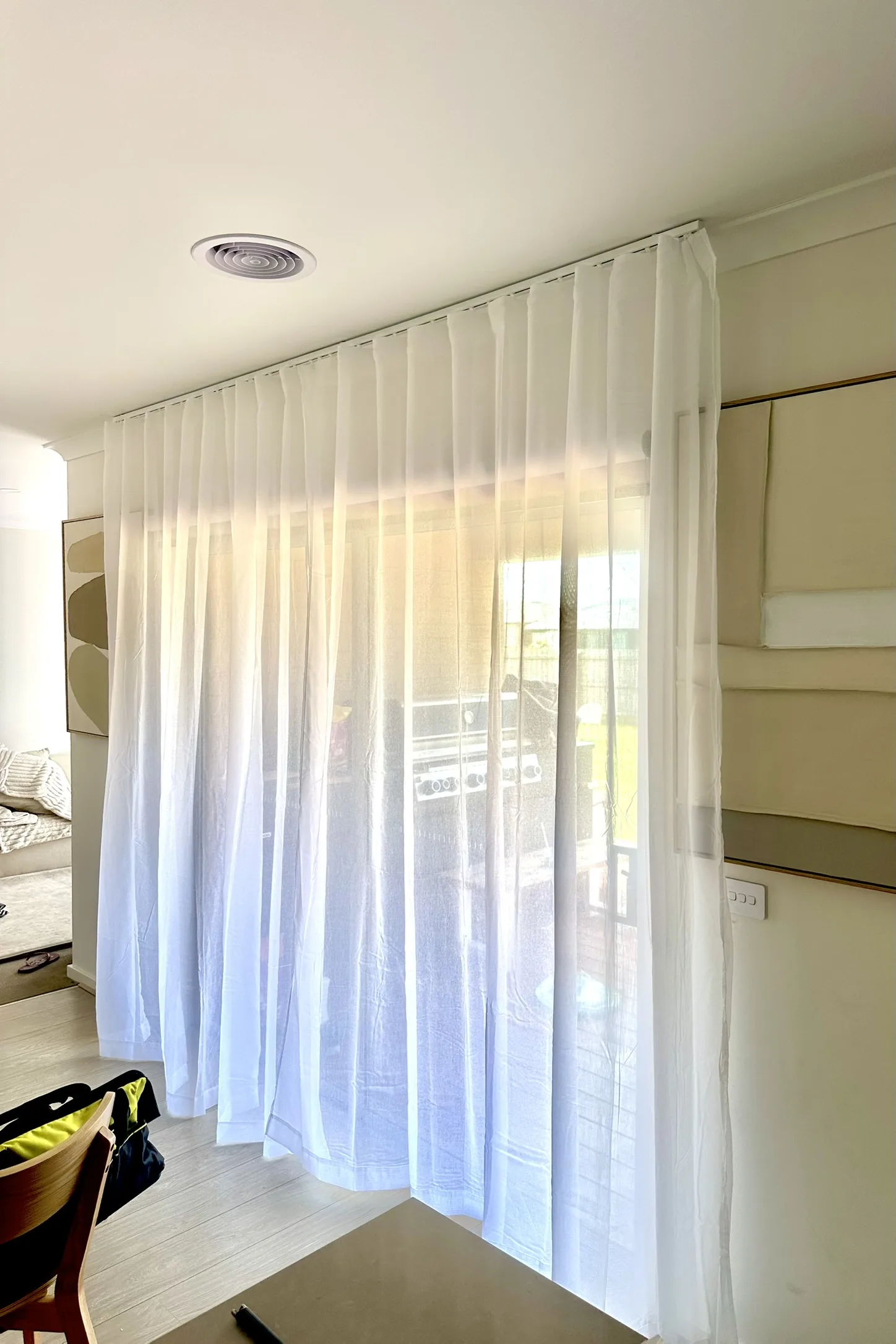
A heavier linen-blend sheer in an off-white or bone tone is the right answer for most west-facing Melbourne living rooms. It filters the harsh afternoon sun without glowing at sunset, drapes with weight, and pairs naturally with a blockout on a double track behind. Sheer curtains have become the default soft furnishing in new Melbourne homes for good reason: they give privacy without darkness, soften the architectural lines of full-height glazing, and read as a serious window treatment when the fabric is chosen well.
Key takeaways
- Fabric weight matters more than colour. A heavy linen-blend drapes; a light polyester voile looks insubstantial.
- Off-white, bone and warm grey hold their character through Melbourne's late western light.
- Specify a double track at frame stage so the blockout can be added later without retrofitting.
- Nettex Bali and Cannes ranges are common Australian sheer options at 300 to 330cm wide.
- Allow three to four weeks lead time on most made-to-measure sheer ranges.
- A floor-to-ceiling drop reads better than a windowsill drop in almost every room.
Why west-facing windows are hard
Melbourne's afternoon sun in summer comes in low and orange through the west between 4pm and 8pm. The angle is shallow, the light is warm, and any thin white fabric will glow with it rather than filter it. That glow is what people mean when they say their sheers "disappear" at sunset.
The answer is a sheer with enough body to hold its own colour against that orange light. Linen-look polyester sheers in the 200 to 300 GSM range do this well. Pure linen does it better but creases more and costs more. Lightweight voiles under 100 GSM struggle. The Nettex Bali range and the Cannes linen-look range are two we use a lot for west-facing rooms because the weave has enough texture to break the light rather than transmit it.
For the underlying heat problem, a bronze solar film on the glass does the work the curtain cannot.
Curtains
Sheers, blockout, S-fold and pinch pleat
Supplied and fitted with the tracks and hardware to match, measured in your own light.
Fabric weight, in plain numbers
The industry talks GSM (grams per square metre) for fabric weight. For sheers:
- 60 to 100 GSM: light voile. Suits bay windows and small openings. Looks insubstantial on a 4m wide opening.
- 120 to 200 GSM: medium weight linen-blend. The default for most living rooms.
- 220 to 300 GSM: heavy linen-look. Reads almost as a drape. Suits high ceilings and feature windows.
For a 2.7m ceiling and a 3.6m opening, a 180 GSM linen-blend in bone or warm grey is a safe spec. For a 3m ceiling and a 5m opening, step up to 220 GSM.
Track choices and ceiling-mounted detail
New builds increasingly run ceiling-recessed tracks rather than wall-mounted rods. The sheer hangs from the ceiling line and reads as part of the architecture. This needs to be planned at frame stage because the track has to drop into a recess in the ceiling. If you are building, get the recess specified before plaster goes up. The builder fit-out checklist walks through this.
Double tracks are standard on new builds. The front track holds the sheer (drawn through the day for soft privacy), the back track holds the blockout (drawn at night for darkness). Specifying both at the same time is significantly cheaper than retrofitting a second track once plaster is up.
Heading choice changes the look
The heading is what determines how the curtain falls. The two common options are S-fold (a continuous wave) and pinch pleat (hand-tied groups of three folds). S-fold is the modern default and suits flat-walled new builds. Pinch pleat suits period homes and panelled rooms. The full comparison is in S-fold vs pinch pleat.
For sheers specifically, S-fold is the more common choice in Melbourne because it suits the contemporary architectural style of most new homes west of the city.
Free measure
Bring the sample books to your place
See the fabrics against your walls and floors before you commit. No charge, no obligation.
Drop and stack: the details that matter
Floor-to-ceiling beats sill-length almost every time. The eye reads the full vertical line and the room feels taller. A 5mm clearance off the floor is the standard install detail; any more and the curtain looks short, any less and the bottom drags on the carpet.
For stack space (where the curtain sits when fully drawn back), allow about 15 to 20 percent of the rod length on each side. On a 4m opening, that is 600 to 800mm of wall on each side that the curtain sits against when open. If you do not have that wall, the curtain will block part of the glass when drawn back.
Common questions
How much do quality sheers cost for a typical living room?
For a 3.6m wide, 2.7m drop opening in a mid-weight linen-blend with S-fold heading on a ceiling track, expect a four-figure number that varies with the fabric range. The fabric is the biggest variable. A free measure walks through three or four ranges so you see the price difference before deciding.
Can sheers go in a bedroom?
They can, but they are rarely the only treatment. Bedrooms need blockout for sleep. The right answer is sheer plus blockout on a double track, or a single blockout roller behind a sheer curtain. Sheers alone in a bedroom let too much light in.
Will sheers fade in west-facing windows?
Quality polyester linen-look sheers from reputable Australian suppliers like Nettex hold colour well for ten years plus. Pure linen will fade faster on west-facing glass. If the room gets full afternoon sun every day of summer, polyester is the safer specification.
What is the lead time?
Three to four weeks for most stock fabric ranges. Longer for some imported linens. We confirm the lead time on the quote so you can plan around it.
A free measure across the western suburbs and inner Melbourne includes sample books from Nettex, Textyles and others. Call Dany on 0468 032 236 or browse the curtains range.
Read next