
Journal · Tint · 6 min read
Safety and security film for ground-floor homes
What it does, what it does not do, and where it is genuinely worth installing.
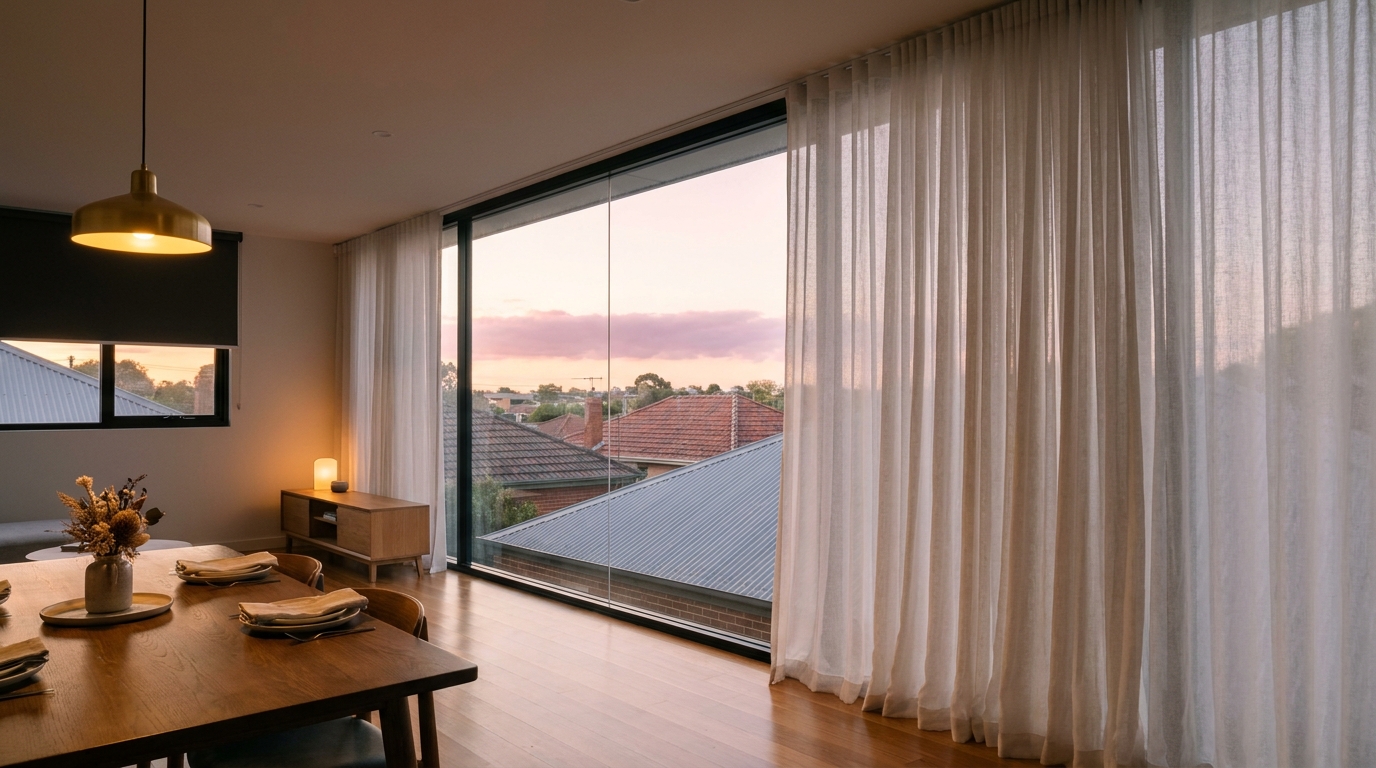
Safety and security film is a clear, thick polyester film (typically 4 mil to 12 mil) that bonds to glass and holds the fragments together if the pane breaks. For ground-floor Melbourne homes, especially those with large sliding doors backing onto a yard, security film on the sliders and adjacent panels is a low-cost upgrade that is invisible until something goes wrong. Quality safety film certified to AS/NZS 2208 Grade A meets the higher impact threshold of the Australian/New Zealand safety glazing standard.
Key takeaways
- Safety film holds shattered glass together; it does not stop a determined break-in.
- AS/NZS 2208 Grade A is the higher certification level for impact performance.
- Standard residential safety film is 4 mil (100 micron); security-grade is 8 to 12 mil.
- Best fitted to large sliding doors, ground-floor windows and glass balustrades.
- Invisible from outside; the glass looks unchanged.
- Pairs naturally with an alarm and quality locks; it is a layer, not a complete solution.
What the film actually does
Safety film is a clear polyester film with a strong adhesive that bonds to the inside of the glass. When the glass is impacted hard enough to break, the film holds the fragments together rather than letting them collapse into the room. The pane itself is broken, but the broken glass is held in place by the film.
The practical effect:
- A broken pane stays in the frame instead of falling into the room.
- An attempted break-in via glass takes minutes longer because the broken glass cannot be cleared.
- A glass impact (a thrown ball, a falling branch, a child running into the door) does not result in shards across the floor.
The film does not prevent the glass from breaking. It changes what happens after it breaks.
AS/NZS 2208 and what certification means
AS/NZS 2208:1996 specifies the functional requirements for safety glazing materials in Australian and New Zealand buildings. The standard sets impact and weather test requirements for film and other glazing products. Two grades:
- Grade A: the higher impact certification. Required for higher-risk applications.
- Grade B: the lower impact certification. Acceptable in some lower-risk applications.
Quality safety film products from reputable manufacturers are typically certified to Grade A at 4 mil (100 micron) and thicker. The certification is held by the film distributor; the installer applies the film and provides documentation linking the install to the certified product.
For any application where the film is being specified for code compliance (rather than just owner preference), Grade A certification is what you want.
Where it belongs in a Melbourne home
The priority spots:
- Large sliding doors at the rear of the house. The single biggest break-in vulnerability in most Melbourne homes is a slider opening onto a yard with no street visibility. Safety film here delays forced entry significantly.
- Ground-floor windows accessible from a side path or yard.
- French doors or large glass entry doors.
- Glass balustrades on stairs and decks (sometimes required by code).
- Overhead glazing in atriums or skylights (also sometimes required by code).
Low-priority spots where film is rarely worth the cost:
- Upper-floor windows not accessible from a balcony or roof.
- Small windows below 600mm that a person could not pass through.
- Windows already protected by security screens or roller shutters.
Film thickness and what it does
Safety film thickness is measured in mils (one mil = 25 microns). The common options:
- 4 mil (100 micron): standard safety film. Holds glass together on impact. Suits residential safety applications. AS/NZS 2208 Grade A certifiable.
- 8 mil (200 micron): security film. Adds meaningful resistance to forced entry. The intruder has to penetrate the film as well as the glass.
- 12 mil (300 micron): heavy security film. Used in high-risk applications. Resists sustained attack with hand tools for several minutes.
For most ground-floor homes, 8 mil security film on the priority panels is the right balance of cost and protection. 4 mil suits glass balustrades and code-compliance work. 12 mil is overkill for residential and is more common in commercial settings.
What film does not do
Three honest limitations:
- It does not stop a determined intruder. Given enough time and tools, any glass can be breached. The film buys minutes, not hours.
- It does not improve thermal performance or block UV by itself (you need solar film for that, covered in UV damage in Melbourne homes).
- It does not replace an alarm system, deadlocks, or sensible operational security like locking sliders when away from home.
Film is a layer in a security system, not a complete system on its own.
Pairing with alarm and locks
The layered approach:
- Quality deadbolts on doors and locks on slider tracks.
- Monitored alarm with sensors on the most likely entry points.
- Safety/security film on the largest accessible glass panels.
- Sensor lighting and street visibility where possible.
The film delays entry. The alarm activates during that delay. The combination is what works.
For commercial applications and AS/NZS 2208 compliance, see commercial window tinting in Melbourne and anti-graffiti film for inner Melbourne shopfronts.
Cost
Safety/security film for residential applications runs $90 to $140 per sqm installed. Per typical 2.4m by 2.1m sliding door, that is a few hundred dollars per panel. Compared to security shutters or grilles, film is the lower-cost option and preserves the look of the glass.
For full pricing context, see the honest cost of window tinting in Melbourne.
Common questions
Will the film be visible on my doors?
No, quality clear safety film is essentially invisible once installed. From inside or outside, the glass looks unchanged. The film thickness is at the edge of perceptibility only when you look closely at the cut edge.
Does film cover all break-in scenarios?
No. A broken slider with a glass-cut latch can still be unlocked from inside if the latch is reachable. The film delays the breach but does not prevent the intruder from reaching through. Quality slider locks that prevent this are a separate, complementary upgrade.
Can film be applied to glass with existing tint?
Generally yes, but the bond is to the glass, so existing film must be removed first. If solar film is also wanted, combination products (one film that handles both safety and solar) exist and avoid the double-install.
Will the manufacturer warranty cover damage from a break-in?
The warranty covers product defects (bubbling, peeling, fade). Damage from break-in attempts is not a defect. The film does its job by absorbing damage; replacement after an incident is a normal part of the product's life cycle.
What about pool fence glass?
Glass pool fencing has specific compliance requirements under AS 1926 and AS/NZS 2208. Safety film on pool fence glass can be a code-compliant retrofit if the original glass is not certified, but the install must be documented. We check on the measure.
A free measure within 40km of Altona walks through which panels are worth filming and which are low-priority. Call Dany on 0468 032 236 or browse residential tinting.
Read next
Related service
Window Tinting →Frost tinting, one-way mirror film, solar heat reduction, decorative and safety film installed across Melbourne